This study caught our attention after the Dutch Cycling Embassy highlighted it, and it’s exactly the kind of evidence we look for at Dutch Cycling Week: hard data that confirms what cyclists have long sensed. Researchers at the National University of Singapore (Hua, Ito & Biljecki, 2026) analyzed thousands of GPS-tracked bike rides in Montreal and linked them to Google Street View images along each route. Using a deep learning model, each street scene was broken down into usable pixels: how much greenery is visible, how much sky, how many parked cars and how much traffic, and how many pedestrians and cyclists. The result is a surprisingly detailed picture of what truly motivates cyclists—and that insight is valuable for anyone building the city of the future.
Cyclists Choose Experience Over Speed
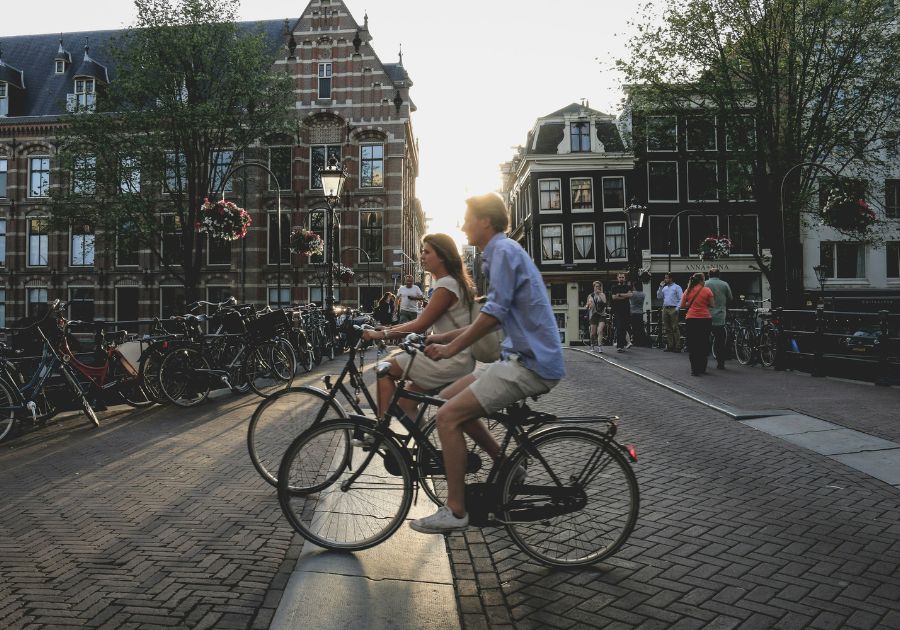
The most fundamental conclusion is also the most important one: cyclists almost never take the shortest route. They consistently trade time savings for a more pleasant ride. Regardless of their destination, people consistently choose streets with more greenery, less motorized traffic, and more other pedestrians and cyclists around them—even if that means taking a detour. This isn’t just an occasional preference of an enthusiastic minority; it’s a pattern that recurs throughout the entire dataset. So anyone who evaluates bicycle infrastructure solely based on distance and traffic flow is measuring the wrong thing.
There is no single bike network that serves all purposes
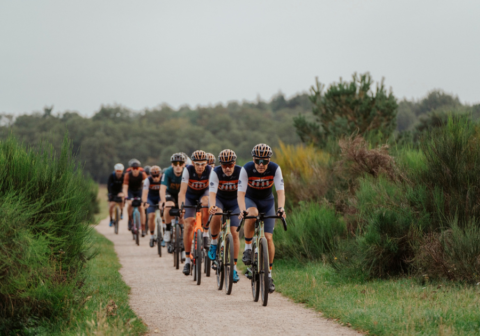
Equally important is that “the cyclist” does not exist. Recreational rides deviate the most from the shortest route: people consciously take longer, varied detours through neighborhoods with a high mix of land uses, higher affluence, and older residents, as if the ride itself were the goal. Commuting behavior is completely different. Commuters choose routes past more expensive homes with less mixed-use development, indicating a preference for quiet, predominantly residential streets over busy mixed-use areas. A grocery run, in turn, calls for something else entirely: short, amenity-rich routes close to home. A single, uniform bicycle network cannot possibly meet all these different needs.
Green spaces and tranquility carry more weight than a few minutes saved
The impact of a green, peaceful environment is particularly significant for commuting and recreational cycling: cyclists are willing to accept a longer ride in exchange for less traffic and a more enjoyable experience along the way. It’s also striking what doesn’t matter. Factors such as temperature, gradient, housing prices, and the month of the year show hardly any variation across different destinations. It is actually the time of day, the density of amenities, and the degree to which the route deviates from the shortest path that explain why someone chooses to bike. This means that comfort and green spaces are not just “nice to have” for the enthusiastic cyclist, but a fundamental factor for everyone.
What This Means for Policy and Design
For urban planners and policymakers, the message is clear. Designing bicycle infrastructure as a single, uniform network misses the point. A commuter benefits from direct, quiet connections between home and work. A recreational cyclist, on the other hand, seeks long, varied, green loops. A grocery run calls for short, frequent connections to local amenities. That distinction should be reflected in how we plan routes, where we add green spaces, and which streets we restrict to motorized traffic. The authors are candid about the limitations: the data comes from a single city, and the sample is not necessarily representative. But the method itself—combining visual street-scene analysis with GPS data and trip purposes—is a template that other cities, including our own, can readily adopt.
We are therefore eager to highlight this theme during the events surrounding Dutch Cycling Week. But as far as we’re concerned, it also belongs squarely on the political agenda, as a building block for the city of the future, where the bicycle is not the exception but the norm.